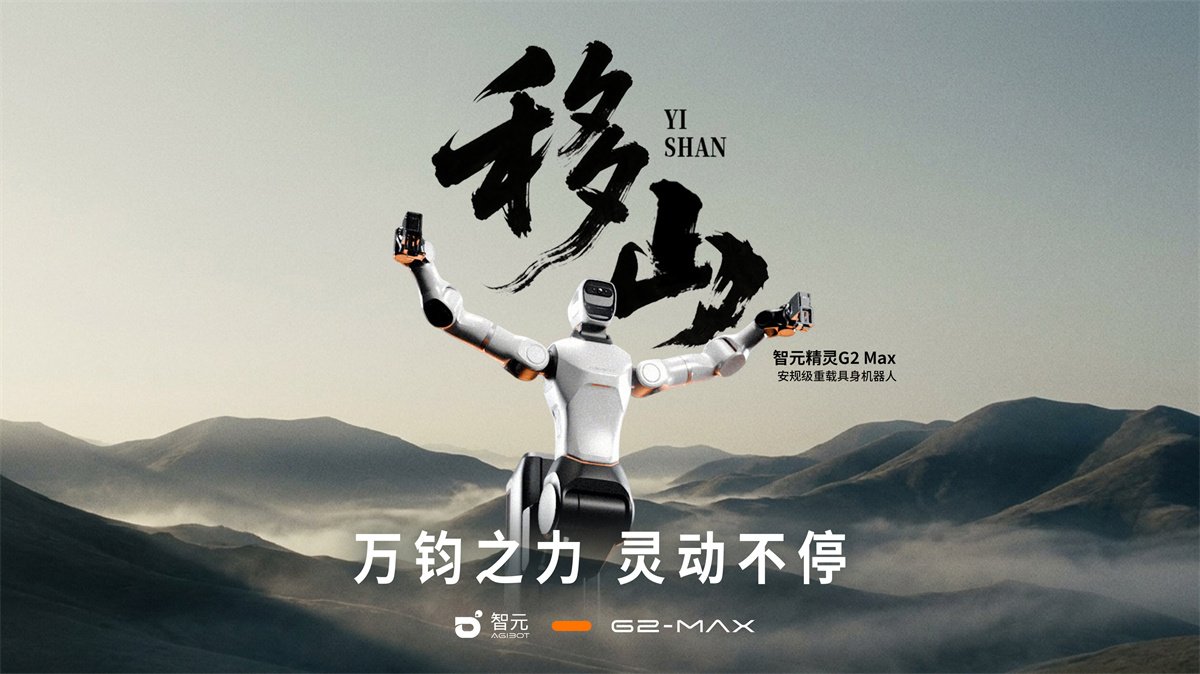
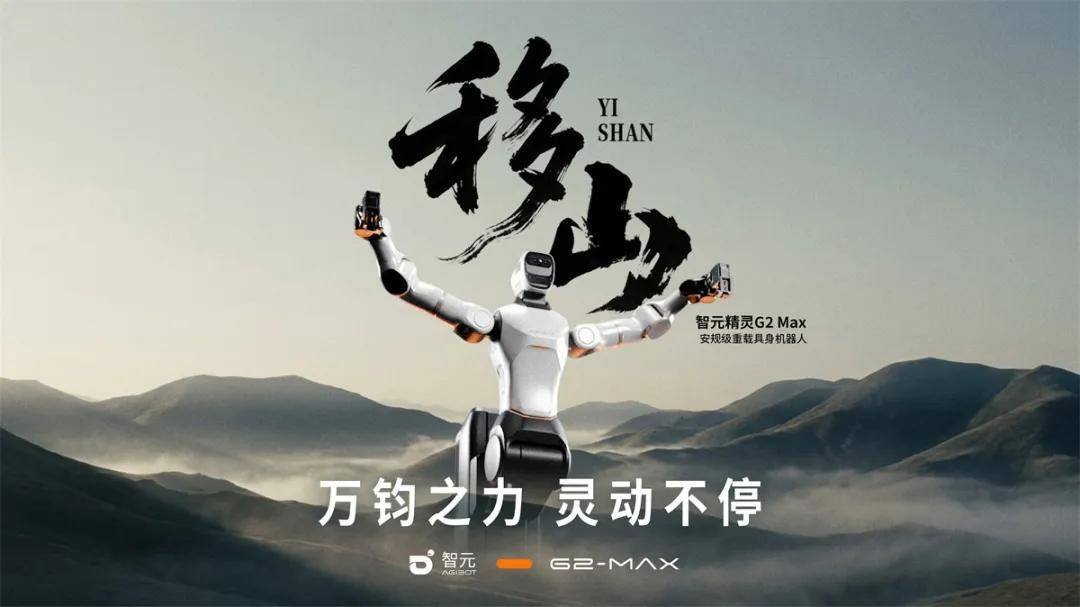
Introduction: On October 26, centered on the AI WAVE goal of "getting robots truly on the job," AGIBOT launched the safety-compliant heavy-duty embodied robot Genie G2 Max. Targeting scenarios such as depalletizing and palletizing, material transfer, and production line feeding, the product translates real-world requirements for strength, precision, and continuous operation into a single concrete product, driving AGIBOT's full-stack AI capabilities onto production lines and converting technical strength into real productivity.
The industrial handling sector has long faced an unsolvable multiple-choice dilemma: heavy-duty equipment cannot do fine work, and precision equipment cannot bear heavy loads. To break this industry deadlock, AGIBOT AI WAVE's third release—the safety-compliant heavy-duty embodied robot Genie G2 Max—is officially launched, achieving both heavy-load strength and sub-millimeter precision operation. It has a single-arm payload of 20 kg, a dual-arm rated payload of 40 kg, a dual-arm peak payload of up to 50 kg, and arm repeat positioning accuracy of ≤±0.5 mm, making it the industry's first heavy-duty embodied robot to achieve long-range, multi-task operation.
"Embodied intelligence is not a lab demo; its value must be tested on real production lines." Yao Maoqing, co-founder, co-president, and president of the Embodied Business System at AGIBOT, said during the G2 Max launch livestream that industrial scenarios impose stringent requirements on robots: they must carry heavy objects and place workpieces accurately, adapt to the existing layout of old factories, and collaborate with production line equipment and upstream and downstream partners. AGIBOT hopes to translate technological accumulation into the production floor, driving embodied intelligence from single-point demonstrations to full-process collaboration and truly unleashing the productivity of embodied intelligence.
Genie G2 Max will also appear at the 2026 AGIBOT INNOVATION DAY on October 29, where it will visually demonstrate the integrated strength of heavy-load capability, fine operation, and all-weather stable operation.
Heavy load and precision combined: one robot completes the full pick, move, and place process
In tasks such as bin transfer, production line feeding, and picking and placing heavy components, robots need to simultaneously meet three requirements: heavy objects must be moved stably, materials must be placed accurately, and operations must keep up with multi-shift production. Especially under heavy-load conditions, robots still need to maintain fine pick-and-place capability and continuously complete repetitive tasks.
To this end, G2 Max integrates heavy-load handling, fine operation, and continuous operation capabilities, connecting the full pick, move, and place process through the same device and adapting to diverse material and process requirements on industrial sites. With a dual-arm payload capacity of 40 kg, G2 Max covers the handling needs of more than 95% of industrial bins and components on the market. However, G2 Max does not simply pursue the ceiling of payload specifications; instead, it invests substantial engineering effort in force control and vision fusion solutions to solve the long-standing problem of "able to move it but unable to place it accurately."
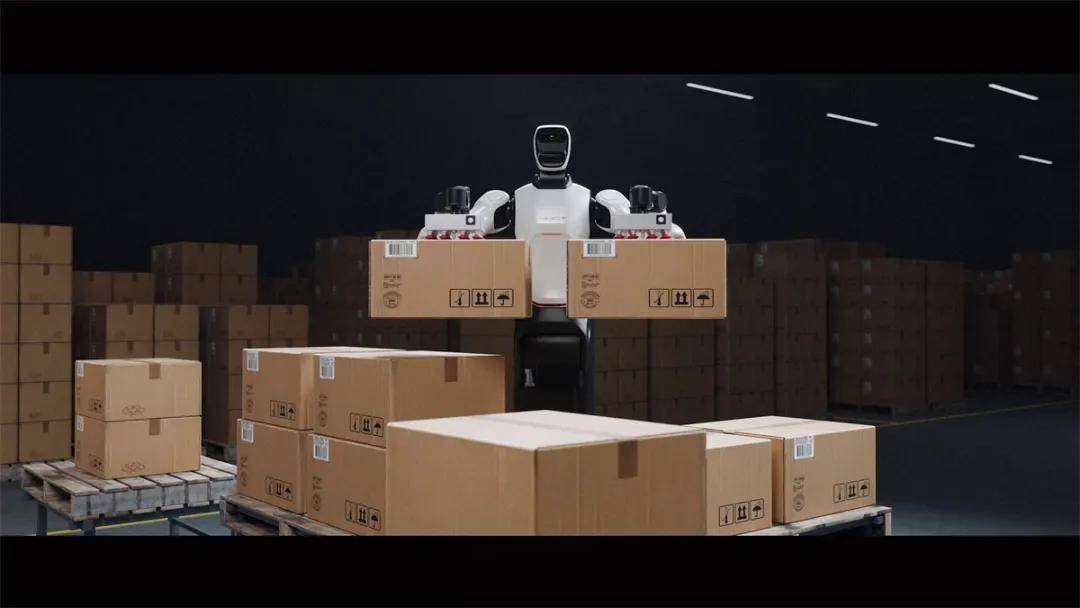
Powered by 7-DOF force-controlled dual arms and equipped with vision guidance + dual-arm force control technology, G2 Max is compatible with a wide variety of industrial materials such as cardboard boxes, Euro-standard turnover boxes, and irregular components, without the need for extensive re-teaching and calibration.
In the mixed-line incoming material scenario of a leading domestic daily chemical FMCG production line, facing material boxes of varying sizes and weights, the robot achieves a 100% material recognition rate, smoothly completing the full long-process workflow of depalletizing, unpacking and feeding, box film covering, and empty box recovery, enabling mixed-line operation of multiple material categories.
Full-domain flexible operation: no production line modification required, improving space efficiency
The biggest obstacle for many factories in advancing automation is the high cost of production line and site modification. Once heavy-duty equipment is brought in, workstations must be torn down and rebuilt, and large movement spaces must be reserved, keeping the deployment threshold high.
G2 Max takes "compatibility with existing production lines" as a core design goal: vertical operating range of 0.1 m to 2.5 m, horizontal operating coverage of 1.2 m; equipped with a high-precision waist pitch joint that can actively tilt the body posture forward to achieve single-side depalletizing and palletizing. Pallets can be placed directly against the wall, with no need to reserve 1.5 meters of bypass workspace behind them, greatly freeing up factory floor area. Low-level picking and high-level palletizing are completed by one machine, without additional lifts or auxiliary tooling.
This spatial adaptability has already been applied in leading e-commerce warehousing scenarios. G2 Max can seamlessly connect to the "goods-to-person" system of automated storage and retrieval warehouses, working with the existing robot system to complete the full process of full-box depalletizing and inbound storage, and empty bin palletizing and recovery. Its overall operation success rate exceeds 99%, with a capacity of 80 boxes depalletized and 75 boxes palletized per hour, enabling automation upgrades directly within the original warehouse layout.
"Robots building robots," stably keeping pace with the production line
On the Qiyuan T1 production line, G2 Max is undertaking a "robots building robots" task.
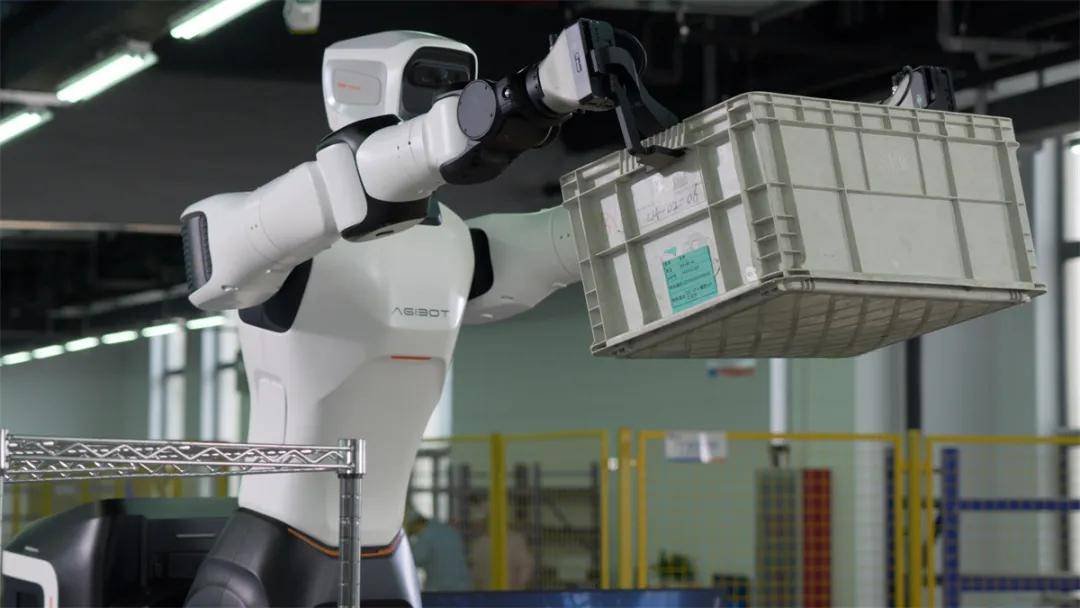
As the "precision handler" on the joint assembly line, it is responsible for accurately delivering processed limb joint components such as shoulder joint housings and hip joint assemblies from the material stacking area to the final assembly workstation. These components are the parts of the robot with the highest precision requirements; even a slight impact on the mounting surface can affect the service life of the joint module. In the past, this relied entirely on manual box stacking, cart pushing, and unloading—arduous and error-prone. After G2 Max came on duty, it carries boxes with both arms and places them with sub-millimeter precision throughout, completing picking, moving, and delivery in one step—using heavy-load and precision handling capabilities to support the birth of another robot.
Facing the production line's takt requirement of rolling one Qiyuan T1 off the line every 2.5 minutes, G2 Max achieves stable matching. Zhou Ye, factory director of the Huguang Co., Ltd. robot manufacturing plant, said: "A 2.5-minute takt means the material supply rhythm for the entire joint assembly workstation must be perfectly synchronized; if it is late, downstream workstations start waiting idle. G2 Max's operation takt is very stable—the all-day takt curve is almost a straight line."
The value of robots also includes withstanding the heavy physical pressure of night shifts. To this end, G2 Max is equipped with a multi-pronged energy replenishment solution featuring dual-battery hot-swapping + autonomous recharging, achieving 7×24-hour uninterrupted operation and filling the gap in human night-shift capacity. At the same time, it is designed in accordance with industrial safety standards, building 360° multimodal perception protection that integrates 2D/3D LiDAR, ultrasound, chassis safety touch edges, and physical emergency stops, enabling safe operation even in complex industrial environments.
Beyond hardware, G2 Max natively supports the Genie Studio 2.0 embodied operation platform. With platform capabilities, customers can quickly complete task orchestration, simulation verification, and cluster operations and maintenance, completing on-site adaptation at day-level speed and greatly shortening project deployment cycles.
Currently, G2 Max has been deployed and operating on multiple production lines and continues to optimize its operational capabilities through collaboration with existing industrial equipment and production processes. In the future, AGIBOT will continue to advance solution iteration and large-scale replication of heavy-duty embodied robots, enabling embodied intelligence to truly enter factories and warehouses and converting the product capability of "tremendous power, ceaseless agility" into the productivity of the real economy.